
Dussehra, also called Vijayadashmi (or Bijoya in Bengal), is the culmination of the nine-day Navaratri celebrations. It is a festival that marks the killing of Ravana, his son Meghanatha and brother Kumbhakarna, by Rama. It is seen as the vistory of good over evil
The Ramayana
The epic Ramayana, describes the story of Rama. Rama was the exiled prince of the kingdom of Ayodhya. While in exile, he lived in the forest with his wife Sita and brother Lakshmana. One day Sita was abducted by Ravana, the demon king of Lanka. Rama, assisted by an army of monkeys and Lakshmana, attacked Lanka to rescue her.
A fierce battle ensued between the two armies for many days. Rama found it very difficult to beat the mighty Ravana. So he prayed for nine days to nine different aspects of goddess Durga and accumulated enough strength to defeat Ravana.
Dussehra celebrates Rama’s victory over Ravana in a festival spread out over ten days. The story of Rama’s life is enacted in a folk art form called Ramlila. Every nook and corner has its own Ramlila, with millions of actors enacting it during Dussehra. Conventionally, only men participated in the Ramlila, but now women, too, have started acting in them.
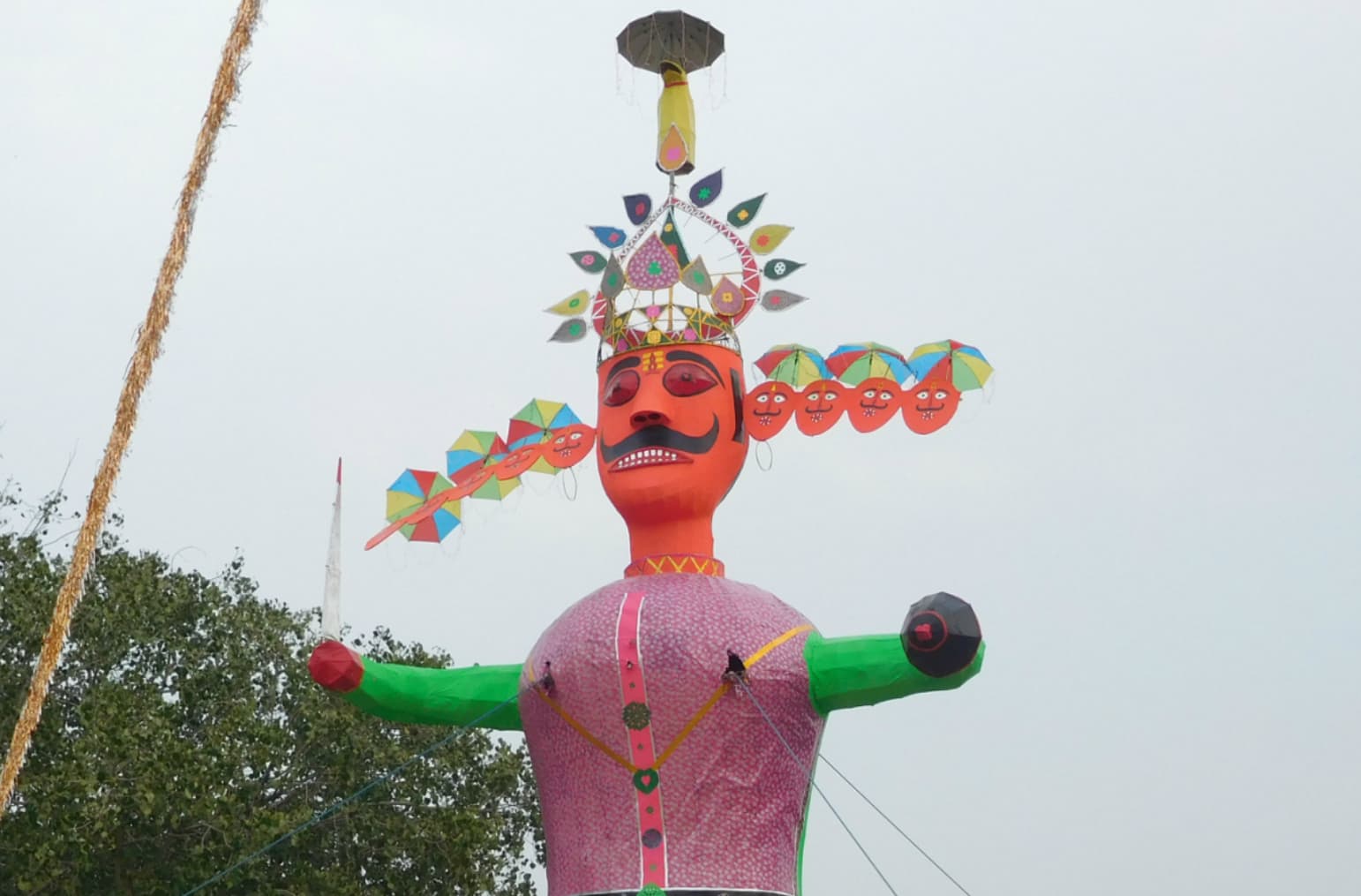
The 10th day is one of fireworks. The final act of this drama is staged. Huge paper effigies stuffed with firecrackers, sometimes almost 100 feet high, of Ravana, his son and brother, are set ablaze. At the appointed hour, a person dressed as Rama, shoots flaming arrows at the effigies, which start to burn.
The Dussehra of Kulu
Although Dussehra is celebrated across India, in some parts the celebrations are especially interesting. Kulu, a small town in Himachal Pradesh, is witness to unique Dussehra celebrations. Since the times of Maharaja Ranjit Singh, who ruled Punjab (which also consisted of parts of Himachal Pradesh), more than 150 years ago, Dussehra celebrations here begin three days after they do in the rest of India.
This is so because the powerful Maharaja expected all kings who paid him homage, to be present at Kulu for the celebration. These rulers would leave immediately after the celebrations in their kingdoms had ended, and head to Kulu. Since it took them three days to reach, this practice was established and has continued ever since.
The lives of the hills people are full of fascinating myths that connect the existence of their very human gods to the natural surroundings — beautiful and harsh alternately. At times like Dussehra, then, if the humans celebrate, wouldn’t the gods rejoice too and have their annual reunion?
Village deities from all around are brought to Kulu in palanquins. The procession is led by musicians and dancers. A large fair is also organised on this occasion.
This is a good opportunity for people to buy and stock their provisions for the harsh winter ahead, as most places become inaccessible due to snow within a month of the festival.
![The Story of Dussehra []](/media/features-104_1.jpg)
The Grand Dussehra of Mysore
In Mysore in the southern state of Karnataka, the celebrations take a unique turn. Instead of effigies of Ravana being burnt, five animals -a rooster, a fish, a lamb, a crab, and a buffalo – are sacrificed instead.
Dussehra is a royal celebration in Mysore. The people of Mysore celebrate Durga Puja, too. They mark Durga’s killing of Mahishasura, who according to myth lived in those parts. The celebrations are held at the Durga temple atop the Chamundi hill, with a breathtaking view. Durga happens to be the family deity of the royal family.
A regal procession of decorated elephants, courtiers and court symbols winds its way to the temple, which is decorated splendidly for the festival. On reaching the temple, prayers are offered to the goddess.
This event attracts many tourists from India and abroad. But given the expenses involved, it has been a royal affair. Lately though, with the decline in the status of the royal family of Mysore, this festival has lost some of its traditional lustre.
The ‘Bommai Kolu’ of Tamil Nadu
In Tamil Nadu, Lakshmi, the goddess of wealth and prosperity, Saraswati, the goddess of learning and arts and Shakti (Durga) are worshipped. Here, and in Andhra Pradesh and Karnataka, families arrange dolls (Bommai Kolu) on specially built steps. They also prepare an elaborate spread of lamps and flowers.
The day of Saraswati puja is a day of special happiness for anyone who has to study for school, college or any exam. On that day, the books are placed before the goddess of learning, with the fervent hope that the owner of the books does well. And no one is supposed to study that day!
In Kerala, too, Vijayadashami is an auspicious occasion for children to commence their education in classical dance and music, and to pay homage to their teachers.
You may also be interested in these:
The Nine Nights of Navaratri
Deepavali: Festival of Lights
The Story of Diwali
Makar Sankranti
Ratha Yatra