

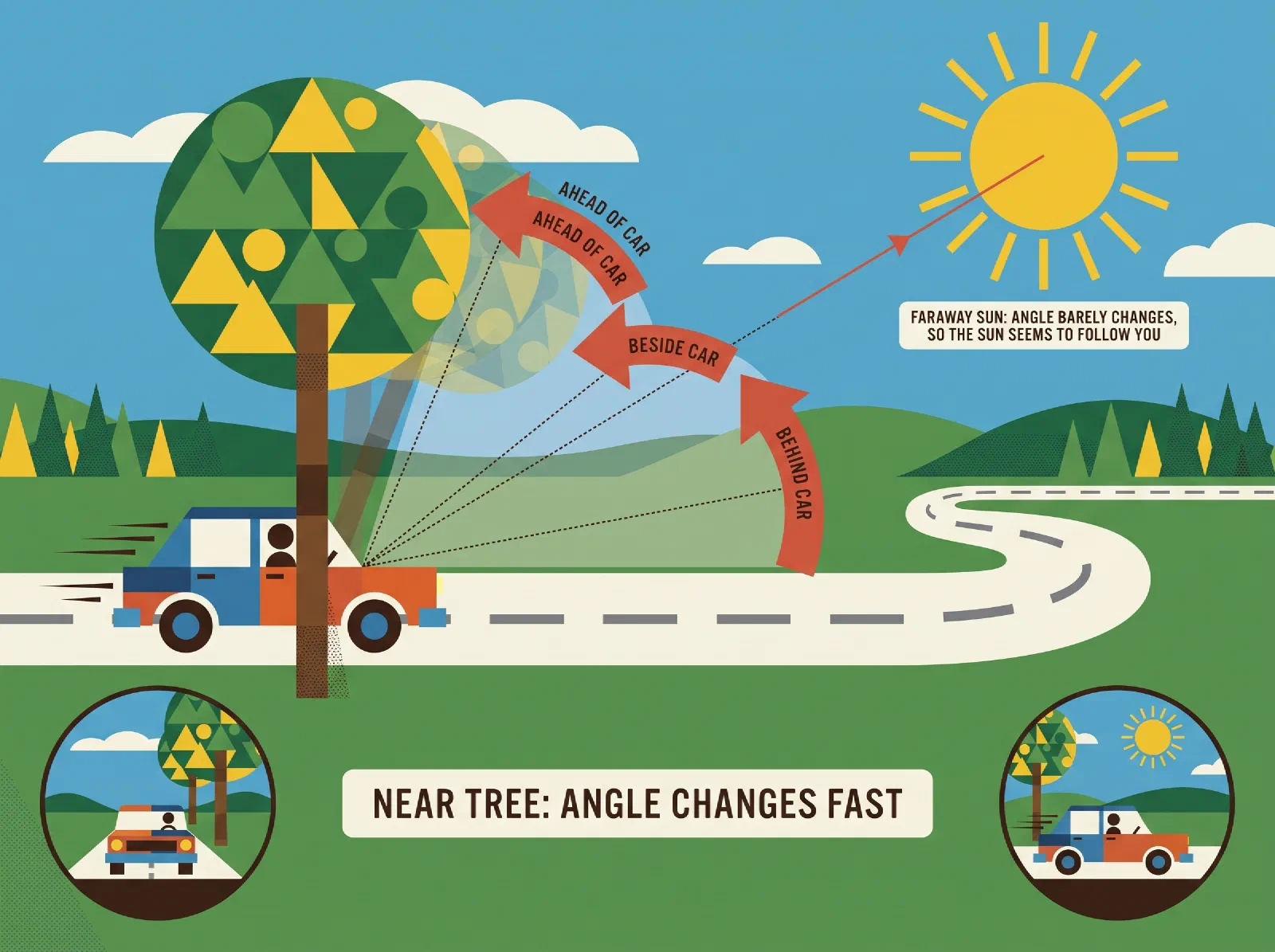
Have you ever noticed that when you are in a car, or a bus, travelling on a straight road, the Sun appears to move right along with you?
While telephone poles and trees close to the road whiz past in the blink of an eye, the Sun is always visible throughout the journey. No matter how fast Daddy drives, you just cannot leave the Sun behind. Why?

It is all about distance
As your car moves, a nearby tree quickly changes its direction compared to you – ahead one moment, beside you the next, then gone behind. We say its angle changes a lot. A faraway hill changes its angle much more slowly, so it stays in view far longer.
And the Sun? The Sun is about 150 million kilometres away. That is so far that driving a few kilometres changes its angle by almost nothing at all. So the Sun appears to stay in the same place beside you, as if it were following you home.
Astronomers call this idea parallax: nearby things seem to shift a lot as you move, while very distant things barely shift at all.
So does the Sun ever move?
The Sun does slowly cross the sky during the day – but not because it is chasing your car. It is because the Earth itself is turning. The Earth spins on its axis once roughly every 24 hours, and as it turns, the Sun appears to rise in the East, climb overhead, and set in the West.
So the next time the Sun seems to follow you, you will know the truth. It is simply so far away that you can never drive out from under it.
Editor’s note: This story was updated in 2026 to explain the real reason – distance and parallax – more simply.
Word treasure
- whiz
- — move quickly past something
- angle
- — the direction of something compared to where you are
- parallax
- — the way near things seem to shift more than far things as you move
- axis
- — the imaginary line a spinning thing turns around